Our Security Posture: How FasterOutcomes Protects Legal and Elective Medicine Data
Trust Is Infrastructure, Not a Line Item
Law firms and elective medicine practices do not hand over ordinary data. They hand over case files, medical records, settlement figures, and patient histories — the material their clients are most exposed by.
So when a firm evaluates an AI platform, the real question is not what the model can do. It is what happens to the record after it is uploaded: where it lives, who can reach it, what leaves the building, and who has checked.
This is how FasterOutcomes answers that, in the order most buyers ask it.
Independently Audited, Continuously Monitored
FasterOutcomes maintains a SOC 2 Type 2 attestation, along with HIPAA and GDPR compliance programs. A Type 2 report matters more than a Type 1: it covers how controls actually operated over a period of months, not whether they existed on the day of the audit.
Our controls are not reviewed once a year and filed away. They are continuously monitored across product security, data security, network security, application security, endpoint security, and corporate security, with evidence collected on an ongoing basis rather than assembled in a scramble before renewal.
The current status of every certification, the underlying control families, and our policy library — access control, encryption, data protection, asset management, communications and network security — are published in our Trust Center. The SOC 2 report itself is available to customers and prospects under NDA.
How Your Data Is Protected
The fundamentals, stated plainly:
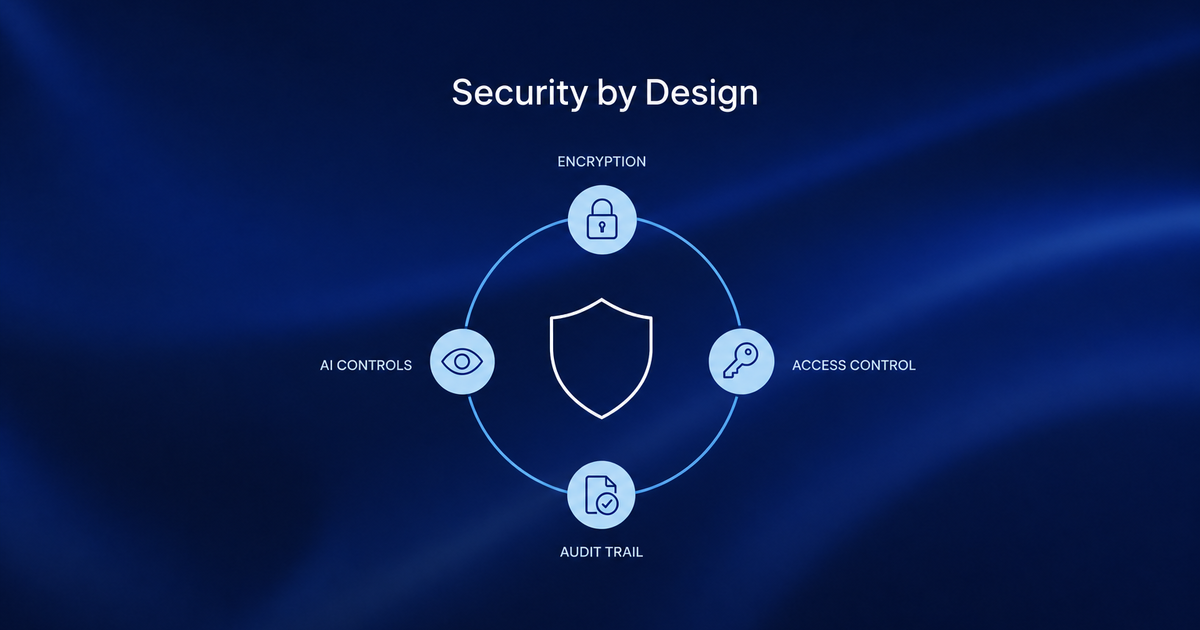
- Encrypted in transit and at rest. Everything moving between your browser and our platform travels over TLS. Everything stored — documents, extracted text, embeddings, and metadata — is encrypted at rest.
- Hosted on Google Cloud. We build on Google Cloud rather than self-managed hardware, which puts your data behind the same physical, network, and key-management controls that back Google’s own infrastructure.
- Secrets are never baked into code or images. Credentials live in a managed secret store, are injected at runtime, and are rotated.
- Tenant isolation. Firm and practice data is segregated by tenant, including dedicated search infrastructure for client knowledge bases, so one customer’s corpus is never queryable from another’s session.
- Production database access is restricted and reviewed. Access to production data is granted by exception, logged, and revoked on role change or departure.
Security Controls Built for AI Workflows
Most security pages stop at the infrastructure layer. AI platforms need to go further, because the interesting risk is no longer only “who can read the database” — it is “what did the model see, and where did it go.”
- We do not train models on your data. Your matters, documents, and patient records are used to serve your workflows. They are not used to improve a shared model.
- Production prompts and outputs stay inside the platform. Third-party AI observability and tracing tools are widely used across the industry to debug model behavior — and they capture prompt and completion bodies as they go. In our production environment that pathway is disabled in code, not by a configuration toggle, so prompt bodies and model outputs cannot be shipped to an external analytics vendor even by accident. Those tools remain available to our engineers in development and staging, where the data is synthetic.
- Outbound access is constrained. Agent tooling that reaches outside the platform is limited to an allowlist of approved services rather than an arbitrary endpoint, and PII-redaction tooling is available on that path.
- Every AI output is traceable. Generated chronologies, summaries, and demand material cite the source document and page they came from, so a reviewer can verify a claim instead of trusting it.
- A human stays in the loop. The platform is built to produce reviewable work product for a professional to approve — not to file, send, or decide on its own.
- AI providers are governed as vendors. Model providers sit inside the same vendor-management and due-diligence process as any other subprocessor, on commercial API terms — not consumer chatbot accounts.
Least Privilege, by Default
Access is scoped to the smallest set of data a role needs. Firm administrators control who joins a workspace and what each group can see; permissions are enforced at the API and database layer, not merely hidden in the interface. Identity is verified through managed authentication with single sign-on, and access to sensitive clinical records is written to an audit trail that records who viewed what and when.
Onboarding and offboarding are controls in their own right. Personnel screening, security and privacy awareness training, and policy acknowledgement are tracked for every member of the team — including contractors — and access is removed on termination as a monitored control, not a best effort.
Every File That Enters the Platform Is Screened
Uploads are the most common way something unwanted gets into a system. Every file that enters FasterOutcomes is scanned for malware before it is processed or made available for download, and files are served through short-lived signed URLs rather than public links.
Integrations Without Stored Credentials
FasterOutcomes syncs with practice management and EHR systems including SmartAdvocate, Clio, Cerbo, Tebra, and Zenoti. That integration layer was deliberately designed so that we do not keep a server-side store of your third-party credentials — there is no vault of customer usernames and API keys for an attacker to target.
Inbound webhooks are verified with HMAC signatures and protected against replay, every tenant-scoped route checks the caller’s tenant claim before returning a record, and integration traffic is rate limited per tenant.
Incident Readiness
We maintain a documented incident response plan covering detection, containment, customer notification, and recovery, supported by centralized logging and monitoring across services. Change management is part of the same picture: production changes are reviewed and approved before release, and customers are notified of material changes.
See It for Yourself
Security claims are worth exactly as much as the evidence behind them. Ours is published rather than described: visit the FasterOutcomes Trust Center for live certification status, the full control inventory, and our policy documents, or read the overview on our Security page.
If your firm has a security questionnaire, a vendor risk review, or a Business Associate Agreement to work through, get in touch — that process is a normal part of onboarding, not an exception to it. Our Privacy Policy and Terms of Service set out how data is handled contractually.
―
Stay Ahead with AI-Driven Legal & Elective Medicine Innovation
Read more insights on the FasterOutcomes Blog.
Read More:- Security and Protecting Your Data