Most personal injury firms already own a case management system, and most of them are now being sold “AI” as a feature of it. The pitch is rarely wrong; it is usually just small. Summarizing a document you upload is useful. It is not the same as a case that moves forward on its own.
This guide covers what AI case management means for a PI firm specifically, why bolt-on AI stalls, what to look for at each stage of a file, and how to evaluate it without replacing the system you already run on.
What AI case management actually means for a PI firm
A case management system is a system of record: it stores the file, tracks deadlines, and tells you what state a matter is in. That is a filing function. It answers “where is this case” and never “what should happen next on it.”
AI case management is the layer that reads what is in the file and acts on it — screening viability from the intake materials, mapping coverage once the reports land, building the treatment record as it arrives, drafting from that record, and carrying the same analysis into the next stage instead of starting over.
The distinction that matters commercially: this is generally not a replacement for your case management system. It sits alongside it. Any vendor whose first requirement is that you migrate off the system your firm runs on is asking for a much larger decision than the one you are evaluating.
Why bolt-on AI stalls
Firms that pilot AI feature-by-feature usually see a real but capped gain, and the reason is structural rather than technical.
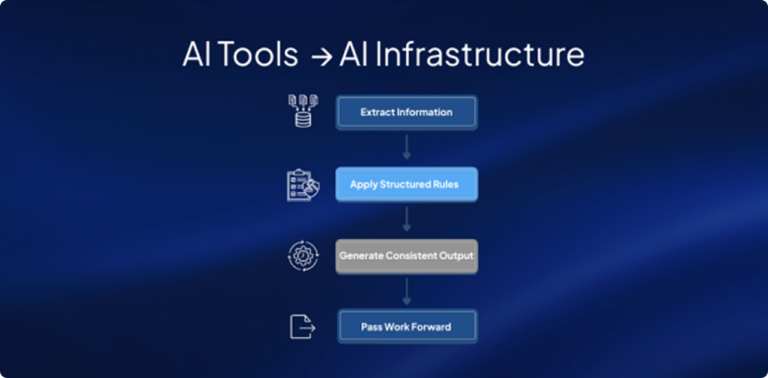
Each feature starts from zero. The summarizer does not know what the intake screen concluded. The demand drafter does not know what the chronology found. Every stage re-reads the file, and a human carries context between them by hand — which is the work that was supposed to be removed.
The gain compounds only when the stages share a record. The evidence preservation letter sent in week one, the coverage map built in month two, and the demand drafted in month eight should all be reading and writing the same file. That is an architecture decision, and it is worth asking about directly, because it is invisible in a feature list.
What to look for, stage by stage
Intake and preservation
Viability screened from the intake materials in minutes, not after a file review next week — and preservation letters out before footage is overwritten. The window here is measured in days and it closes quietly.
Liability and coverage
Fault, defendants, and every insurance source mapped once the reports and statements are in. The failure mode this addresses is the second policy nobody found, which is worth more than most efficiency gains on the same file.
Medicals and treatment
The chronology built as records arrive rather than assembled at the end, with treatment gaps flagged every 30 to 60 days — while the client can still act on them. This is where case value actually lives, and where a static end-of-file report arrives too late to change anything.
Demand preparation
Valuation and a first draft built from the file once treatment stabilizes, with every fact cited to the record. If the drafter cannot see the chronology directly, you are re-entering it.
Negotiation
The offer checked against your own valuation, and the settle-or-litigate math laid out at impasse. The useful output is an argument, not a number.
Litigation
The record built at intake carries into discovery, depositions, and trial documents. Nothing starts over. This is the clearest test of whether stages actually share a file: ask what the system knows in litigation that it learned at intake.
How the categories differ
- Case management systems with AI features. Strong systems of record, adding assistive features. The features tend to be document-level and stage-local rather than case-level.
- Point solutions. One stage done very well — chronology, or demands, or intake. Genuinely valuable, and the integration burden of running four of them lands on your staff.
- General-purpose AI assistants. Flexible and cheap to start. No persistent case record, no deadline awareness, and no way to verify an assertion against a source page.
- Case-level AI layers. Work the file across stages on a shared record, alongside the case management system you already have.
Eight questions to ask a vendor
- Does this replace our case management system or work with it — and which systems do you integrate with today?
- What does the system know at stage five that it learned at stage one? Show me.
- Where does a human decide, and where does the system act without being asked?
- Is every generated output traceable to a source document and page?
- What happens on a case that does not fit the standard path — a minor, a wrongful death, a disputed-liability file?
- How much configuration is needed before it reflects how our firm actually runs a case?
- What does month three look like for a paralegal, in specifics, compared with today?
- What are the failure modes, and how do we find out something went wrong?
Question 2 is the one that distinguishes a case-level product from a bundle of features. Ask for a demonstration rather than an answer.
A 30-day way to evaluate
Week 1. Map your own stages first, before any demo. Where does a file actually wait in your firm? Most firms discover the bottleneck is not where they assumed, and the answer should drive the evaluation.
Week 2. Run three closed files through the stages that matter most to you. Grade against what your team actually produced, not against the vendor’s example output.
Week 3. Put one live file on it end to end with a paralegal who is sceptical. Sceptical staff find the failure modes that enthusiastic staff route around.
Week 4. Measure the handoffs, not the tasks. Time saved inside a stage is easy to demo; time saved between stages is where a case-level system either proves itself or does not.
Where this fits at FasterOutcomes
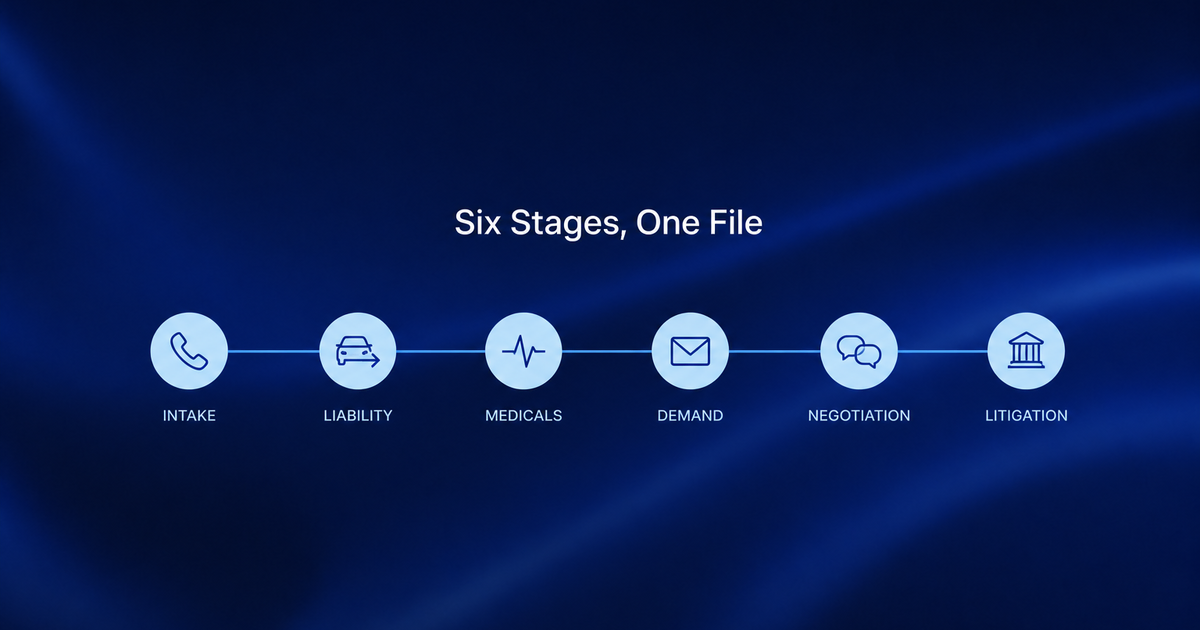
Saxon works the file across all six stages — intake and preservation, liability and coverage, medicals and treatment, demand preparation, negotiation, and litigation — on one shared record, so the case keeps moving forward instead of starting over at each stage.
The analysis layer is Playbooks, with playbooks built specifically for personal injury. The treatment record comes from Medical Chronology, and the firm’s own work product is searchable through Knowledge. We integrate with existing practice management systems rather than asking firms to migrate — see Partnerships. Data handling is set out on our Security page.
Frequently asked questions
What is AI case management for personal injury firms?
It is a layer that reads the contents of a case file and advances it across stages — screening viability, mapping coverage, building the treatment chronology, drafting the demand, and carrying that same record into negotiation and litigation — rather than only storing documents and tracking deadlines.
Does it replace our case management system?
It should not have to. A case-level AI layer works alongside the system of record your firm already runs on. Treat a required migration as a separate and much larger decision than the one you are evaluating.
How is this different from the AI features in our current system?
Most built-in features act on one document at one stage and do not carry what they learn forward. The difference is whether the stages share a case record, which is what allows the gain to compound rather than cap out.
What about cases that do not fit a standard path?
Ask specifically. Wrongful death, minors, and disputed-liability files are where stage templates break, and how a vendor answers this question tells you whether the product encodes a workflow or a rulebook.
Will it replace paralegals?
The pattern firms report is capacity rather than headcount — carrying the reading and assembly that used to cap how many files a team could run, so the same team takes on more cases.
How long before it reflects how our firm runs a case?
That depends almost entirely on configuration depth, which is why it is worth asking as a scoping question during evaluation rather than discovering it during rollout.
―
Stay Ahead with AI-Driven Legal & Elective Medicine Innovation
Read more insights on the FasterOutcomes Blog.
Read More:- AI Demand Letter Software: A 2026 Buyer’s Guide