The demand package is where a personal injury file either realizes its value or quietly loses it. It is also the point where the work becomes least parallelizable: one person, holding the whole file in their head, writing for days.
AI demand letter software is aimed at that bottleneck. This guide covers what the category is, what separates a real product from a template filler, the questions worth asking a vendor, and how to test one on your own files.
What AI demand letter software actually is
It is software that reads the assembled file — medical records, bills, liability documents, wage loss, policy information — and drafts the demand from what is in it, rather than merging fields into a form.
That distinction is the whole category. A template with merge fields still requires a human to read the file and decide what goes in each field; the document generation was never the expensive part. A system that drafts from the record takes on the reading and the synthesis, and produces a first draft that already knows what the treatment history says.
Why the demand package changed
Adjusters now read demands with their own analytical tooling. A package that asserts a treatment course without pinning it to pages invites a request for the underlying records and another sixty days. The demand that moves fastest is the one that is easiest to verify.
At the same time, the volume of supporting material has grown to the point where assembling the exhibit set is a project of its own. The document is short; the file behind it is not.
Both pressures push the same direction: the value is in a draft that is sourced, complete, and assembled — not in prose generation.
The five capabilities that actually matter
1. Drafted from the file, not from a template
Ask to see a draft produced from a file the vendor has not seen. A template filler produces confident, generic paragraphs with the specifics missing or hedged. A system reading the record produces a draft that names the provider, the procedure, and the date — because it found them.
2. Every fact cited to the record
Each assertion in the draft should carry the document and page it came from. This does two things: it lets your attorney verify the draft in minutes instead of re-reading the file, and it makes the package defensible when the adjuster pushes back on a specific claim.
3. Valuation you can show your work on
A number without a derivation is not useful in a negotiation. What you want is the specials broken out, the treatment course that supports the general damages argument, and the comparable reasoning made explicit — so that when the counteroffer comes, you can answer it with analysis rather than instinct.
4. Your firm’s voice and format, retained
Demand packages are firm work product with conventions built over years — structure, tone, the order of the sections, the exhibit numbering your local adjusters expect. A tool that produces excellent prose in the wrong shape creates rework. Ask how the system learns your format, and whether that is a configuration or a services engagement.
5. Knowing when the file is ready
The most expensive demand error is sending early. Value the case before treatment stabilizes and you leave money on the table permanently. A system that watches the treatment timeline and tells you when the file has stabilized is doing something a template never could.
How the categories differ
- Document assembly in your case management system. Merges known fields into a saved template. Fast, reliable, and it does not read the medical records — a person still does that first.
- Outsourced demand writing. A vendor writes the package. Quality varies with the writer, turnaround runs in weeks, and the reasoning behind the draft leaves with them.
- General-purpose AI. Will produce fluent demand prose from a prompt. The risk is precisely that fluency: without citations tied to your record, a confident sentence about a treatment that did not happen reads exactly like a true one.
- Purpose-built demand software. Reads the assembled file, drafts with citations, values the case from the specials and the treatment course, and assembles exhibits.
Eight questions to ask a vendor
- Can you draft from a file I supply, today, without preprocessing it?
- Is every factual assertion in the draft linked to a source page I can open?
- How is the valuation derived, and can I see the components?
- How does the system handle a fact it cannot find support for — omit, flag, or assert?
- Can it match our existing demand format and exhibit numbering, and what does that take?
- What tells us the file is ready for a demand rather than needing more treatment?
- When new records arrive after the draft, what has to be redone?
- Who reviews the output before it leaves, and what does your product do to make that review fast?
Question 4 is the one to press hardest. A system that silently asserts unsupported facts is worse than no system, because the error arrives dressed as work product.
A 30-day way to evaluate
Week 1. Take three demands your firm has already sent and settled. Feed the same underlying files in. You are not looking for a match — you are looking for whether the draft found the facts your team found.
Week 2. Have the attorney who wrote each original mark up the generated draft. Count missing facts, wrong facts, and unsupported assertions separately.
Week 3. Run a live file end to end and time the review, not the generation. Generation speed is a vendor metric; review time is your cost.
Week 4. Send one. A demand that never goes out has not been tested. Watch what the adjuster asks for — the requests tell you exactly what the package failed to make verifiable.
Where this fits at FasterOutcomes
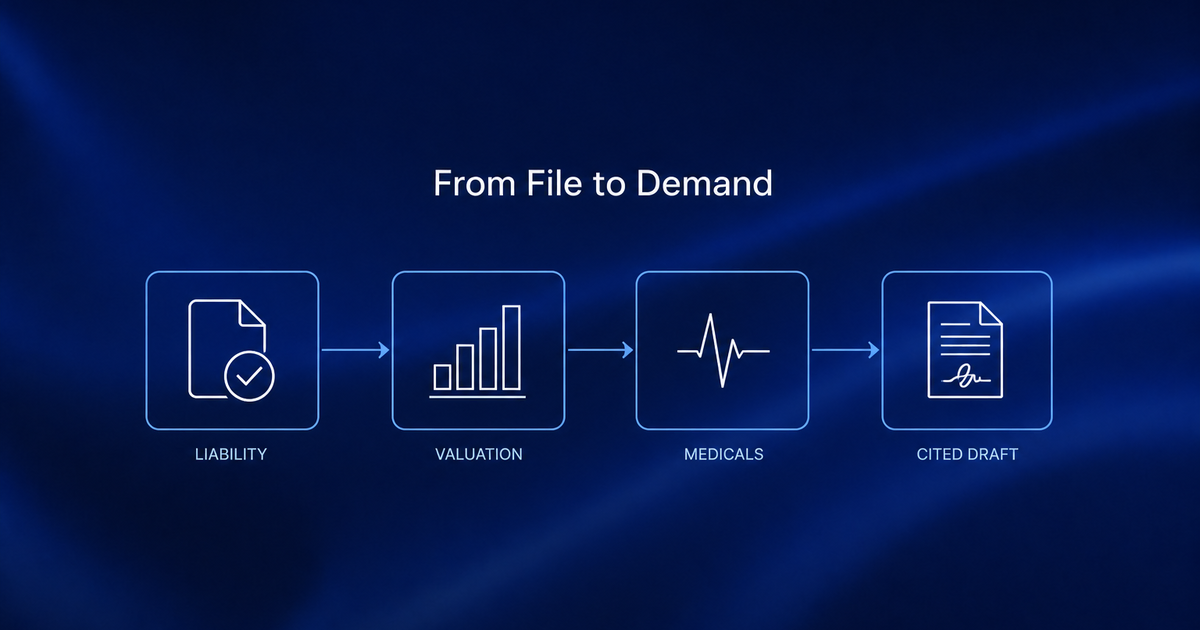
Saxon values the case and drafts the demand once treatment stabilizes, with every fact cited to the record, then carries the same file into negotiation — checking an offer against your own valuation and laying out the settle-or-litigate math at impasse. Demand preparation is stage four of six, not a standalone document generator, which is why the chronology built in stage three is what the draft is written from.
The underlying analysis runs on Playbooks, and the treatment record it draws on comes from Medical Chronology. How your files are handled is set out on our Security page.
Frequently asked questions
What is AI demand letter software?
AI demand letter software reads an assembled personal injury file — records, bills, liability documents, wage loss — and drafts a demand package from the contents of that file, citing each factual assertion back to the source document and page.
How is it different from a demand template?
A template merges fields a person has already filled in, so the reading and synthesis remain manual. Demand software performs the reading and produces a draft populated from the record itself.
Is an AI-drafted demand letter safe to send?
It is safe to send after an attorney has reviewed it, which is the same standard as any draft. What makes that review fast enough to be practical is source citation: verifying a cited assertion takes seconds, while verifying an uncited one means re-reading the file.
Can it match our firm’s demand format?
A serious product adapts to your structure, tone, and exhibit conventions rather than imposing its own. Ask whether that is configuration or a custom services engagement — the answer determines how quickly a second office can adopt it.
When should a demand go out?
Generally once treatment has stabilized, so the specials and the prognosis are settled. Software that monitors the treatment timeline can tell you when the file has reached that point instead of leaving it to a diary date.
Does it replace the attorney’s judgment on value?
No. It produces a derivation you can inspect — specials, treatment course, and the reasoning behind the number — so the attorney is adjusting a documented starting point rather than building one from a blank page.
―
Stay Ahead with AI-Driven Legal & Elective Medicine Innovation
Read more insights on the FasterOutcomes Blog.
Read More:- AI Medical Chronology Software: A 2026 Buyer’s Guide