AI implementation works best when you prepare your strategy, workflows, data and people before you ask software to solve the problem.
I see med spa owners approach AI the same way they approach other major purchases: watch a demonstration, compare a few features and hope the new system makes everyone more productive.
That sequence is backward. Before you choose an AI tool, you should know exactly what you want it to improve, what information it needs and who will be responsible for the result. An AI rollout is a change in how the practice works, not just another software subscription.
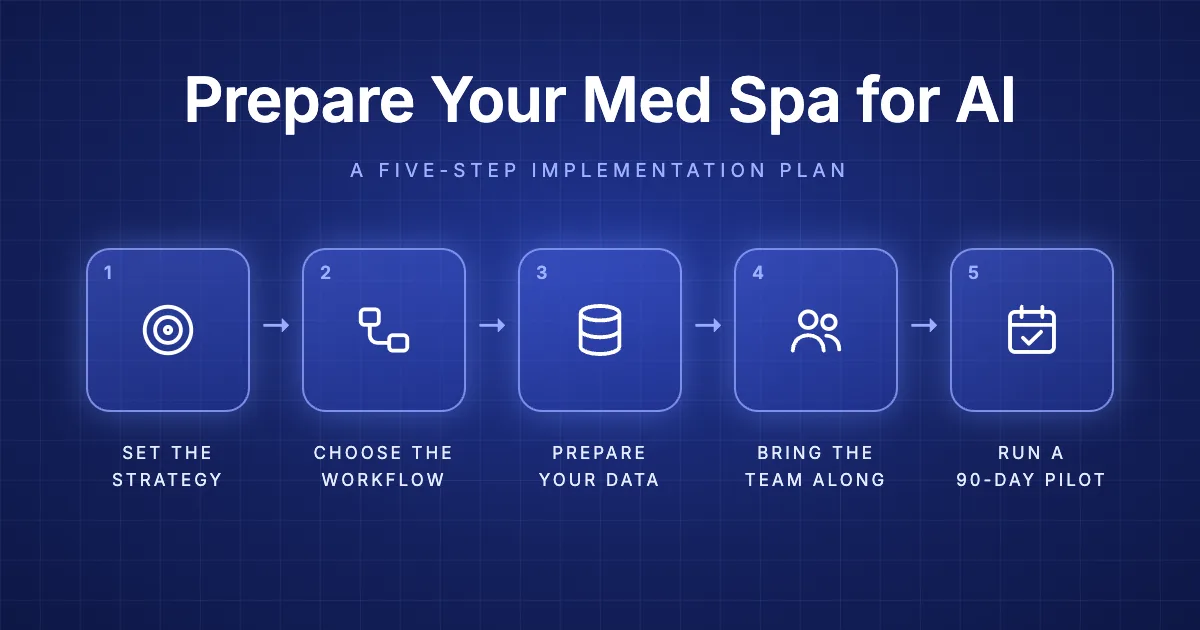
Here is the five-step plan I’d use.
Step 1: What should a med spa decide before shopping for AI?
Start with the practice strategy and one measurable problem—not a vendor’s feature list.
Are you building an efficient, focused injection practice or a broader aesthetics and wellness center? The answer affects which patient information matters, how complicated your workflows become and what kind of technology can help.
Map the journey from inquiry to consultation, treatment, follow-up and rebooking. Note where staff repeat work, where patients wait and where important details get lost. Then choose one outcome: answer more calls, reduce time spent preparing for consultations, improve follow-up completion or make clinical protocols easier to access.
Write down the baseline. If your front desk answers 70% of calls, you need that number before you can credibly say an AI receptionist helped. If clinicians spend significant time gathering records before visits, measure that work before introducing an AI assistant.
And choose an owner. A new system with no one responsible for training and evaluation rarely improves itself.
Step 2: Where can AI deliver useful value in a med spa?
Evaluate AI by the workflow it improves, the risk it introduces and the result you can measure. Not every task needs the same kind of system.
Which administrative workflows make sense first?
Scheduling inquiries, missed-call follow-up, reminders and routine administrative communications are reasonable places to explore automation. These tasks can be measured through response time, booking completion and staff workload.
But set boundaries. An AI receptionist should not improvise medical advice or promise a procedure is appropriate for someone it hasn’t evaluated. It needs approved answers, escalation rules and ongoing review.
How can AI support consultations and patient care?
In clinical workflows, the value is in preparing information for a qualified clinician—not making the final decision. AI may help bring together intake information, prior treatments, patient goals and approved protocols so the provider can review a more complete picture.
FasterOutcomes’ Colette clinical intelligence platform is designed around that distinction: AI prepares an assessment and draft plan from the practice’s patient information and protocols, and the clinician reviews and approves the plan before it reaches the patient.
Clinical workflows deserve tighter controls than routine scheduling. Start where the information and accountability are clear.
Step 3: How should med spas prepare patient data for AI?
AI readiness requires reliable records, appropriately connected systems and clear rules for patient information.
Find out where your patient information actually lives: scheduling software, the clinical record, intake forms, photos, lab reports, emails and spreadsheets. Ask whether your team can access a complete, current record when needed and who is permitted to see each part.
A practice does not necessarily need to replace its existing system of record. In many cases the better approach is to connect an appropriate tool to the systems staff already use, with a clear source of truth and a defined workflow for correcting errors.
Before giving a vendor access to patient information, ask:
- What data will the system access, retain or share?
- How does it connect to our current systems, and what happens when information is missing or contradictory?
- Who can access transcripts, photos, labs and generated plans?
- Is patient information used to train a general-purpose model?
- Can we retrieve or delete our information under the contract and applicable law?
- Does the vendor sign a business associate agreement when HIPAA requires one for our relationship?
- Can the clinician see the evidence and practice protocol behind a suggested plan?
- What safeguards, audit logs and human approvals are in place?
The U.S. Department of Health and Human Services’ business-associate guidance explains when covered entities and vendors need BAAs. Not every med spa or vendor relationship has identical obligations; confirm what applies to your practice. Also confirm applicable patient-consent and state recording requirements before recording or transcribing consultations.
Step 4: How do you get your team to adopt AI?
Treat AI like a new team member whose work needs training, supervision and feedback. Adoption does not happen because the owner announces that a tool is live.
At Spa 35, some providers were initially concerned that consultation transcription would be used to monitor their mistakes. That reaction made sense: if a team doesn’t understand why information is being collected or how it will be used, even a promising tool can feel threatening.
We had to explain the purpose, involve providers in how insights would be used for coaching and show how the process could help the patient. A clinician may care much more about having a useful plan and less repetitive charting than about a revenue dashboard. Talk about the benefit in terms that matter to each role.
Practical adoption looks like this: train the front desk and clinicians together; identify what the tool can and cannot do; review its early outputs closely; create a way to report mistakes; and monitor whether staff actually use it. Managers need support too—they often carry the daily work of turning a decision into a habit.
Step 5: What does a realistic 90-day med spa AI plan look like?
Use the first 90 days to establish readiness, run one carefully supervised pilot and decide whether it deserves to expand. The schedule is an illustrative framework, not a promise that every integration or clinical deployment can be completed in that time.
Days 1–30: Prepare
Audit the patient journey, data sources and existing vendors. Choose one initial use case and a responsible owner. Set starting measures such as call-answer rate, consultation preparation time, follow-up completion or rebooking. Review privacy, security, contract and consent requirements.
Days 31–60: Pilot
Configure one capability with limited scope. Train the people using it. Test normal cases and exceptions. For clinical applications, confirm that a qualified clinician reviews the output and that documentation shows what they approved or rejected. For transcription, verify that patient notices, consents and recording practices comply with applicable requirements.
Days 61–90: Evaluate and improve
Compare results with your baseline. Review mistakes, staff feedback and patient experience. Decide whether to adjust the process, continue the pilot, expand cautiously or stop. Document what worked before introducing the next tool.
What should be on a med spa AI readiness checklist?
Use this list to identify gaps before signing a contract—not to declare a practice universally “AI ready.”
- We can explain the business problem we want AI to solve.
- We have baseline measures and a person accountable for the pilot.
- We know where our patient information lives and which records are reliable.
- We have reviewed vendor access, security, contracts and any required BAAs.
- We have checked consent and recording requirements where applicable.
- Our clinical protocols are documented, current and approved.
- Qualified clinicians remain responsible for clinical decisions.
- Staff understand how the tool will—and will not—be used.
- We have a process for correcting mistakes and evaluating performance.
If you can’t check every box, that’s useful information. It tells you what to work on before expanding the project.
How do you know when you’re ready to scale AI?
Scale only when the first workflow produces useful, measurable results without creating unacceptable clinical, privacy or operational risks.
A med spa doesn’t need to automate everything. It needs a repeatable way to choose problems, test solutions and improve. Colette for med spas illustrates one direction for practices ready to explore clinician-reviewed preparation: gathering intake, goals, treatment history and practice protocols before the visit so the clinician starts with better context.
The objective isn’t to win a race to install the most tools. It’s to give your patients and providers a better experience, one controlled improvement at a time.
Next in this series: Beyond Scheduling: How Clinical AI Can Support Better Med Spa Consultations