OI for AI: Operating Intelligence for AI-Powered Law Firms
Operating Intelligence (OI) is the operational foundation that helps law firms standardize workflows, preserve institutional knowledge, improve decision-making, and establish accountability. AI-powered systems like Saxon™ help firms put that intelligence into practice.
Like most law firm owners I’ve worked with, you probably know you need systems to run your firm efficiently and scale profitably. You may have even documented your SOPs along the way. But, if you’re like most busy firms, keeping them up to date fell off the to-do list long ago. What’s left is a binder full of good intentions.
You meant to document how intake works, how a new matter gets opened, and what happens when discovery lands. Then a client called or a deadline hit, and the binder went back on the shelf.
As a result, your procedures live where they’ve always lived: in your head, and in the heads of the one or two people you can’t afford to lose.
Coaxing Isn’t a System
Even when systems do get written down, round two begins: getting the team to follow them. You remind. You retrain. You send the “per my last email” email. Somewhere along the way, you became part manager, part cheerleader, part hall monitor.
I’ve spent 30 years helping businesses tighten their operations, and here’s what I’ve seen time and again: a procedure that people have to be talked into following isn’t a system. It’s a suggestion.
How Can AI Improve Law Firm Operations?
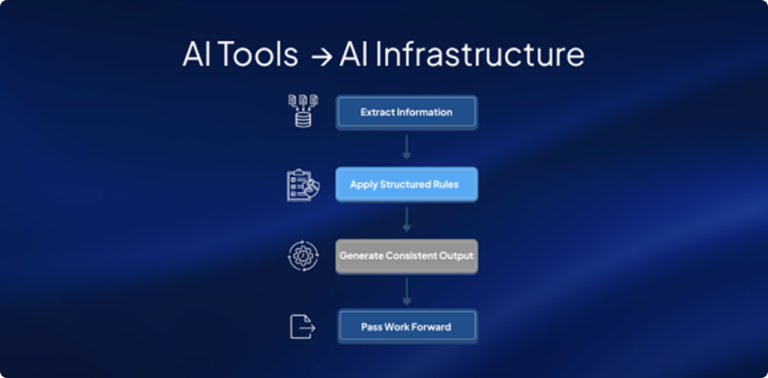
The right AI system flips the script. The procedures you always meant to document are captured, step by step, for every matter type. And instead of coaxing your team to follow them, the workflow simply runs. The next step is ready. One click, and it’s done. Consistently, every time.
That’s true Operating Intelligence: optimized workflows, built in and ready to run.
Stop Being the Hub of the Wheel
For years, I’ve coached law firm owners on one non-negotiable: if you want to scale profitably and reliably, you need a strong operational foundation.
Here’s why. In too many firms, the owner is the hub of the wheel. All work flows out from the center, and every spoke, every team member, waits on the owner for instructions or information. Nothing moves until the hub turns. It works, until it doesn’t. The firm grows, the spokes multiply, and eventually the hub cracks. That’s not a growth plan. That’s a countdown.
Firms that scale look different. Their systems stand on their own. Instructions are documented and consistently followed, so team members don’t have to ask. They already know. That builds independence, ownership, and accountability. Work moves smoothly through the team, not through the owner’s inbox at 10 p.m.
As a COO with over 15 years in the legal industry, I’ve helped over 1,000 law firm owners build systems, hire and train teams, and scale profitably. The owners who got to have dinner with their families were the ones that stopped being the hub and built systems that their team could run without them.
The right AI platform builds Operating Intelligence into your foundation.
The Shift, at a Glance
| Traditional operations | AI-powered operations |
|---|---|
| The owner hands out every task | Playbooks guide every step |
| Know-how lives in people’s heads | Know-how lives in the system |
| Quality depends on who’s working | Quality is consistent, every time |
| Growth means more chaos | Growth means more capacity |
| Bottlenecks occur | Work flows freely |
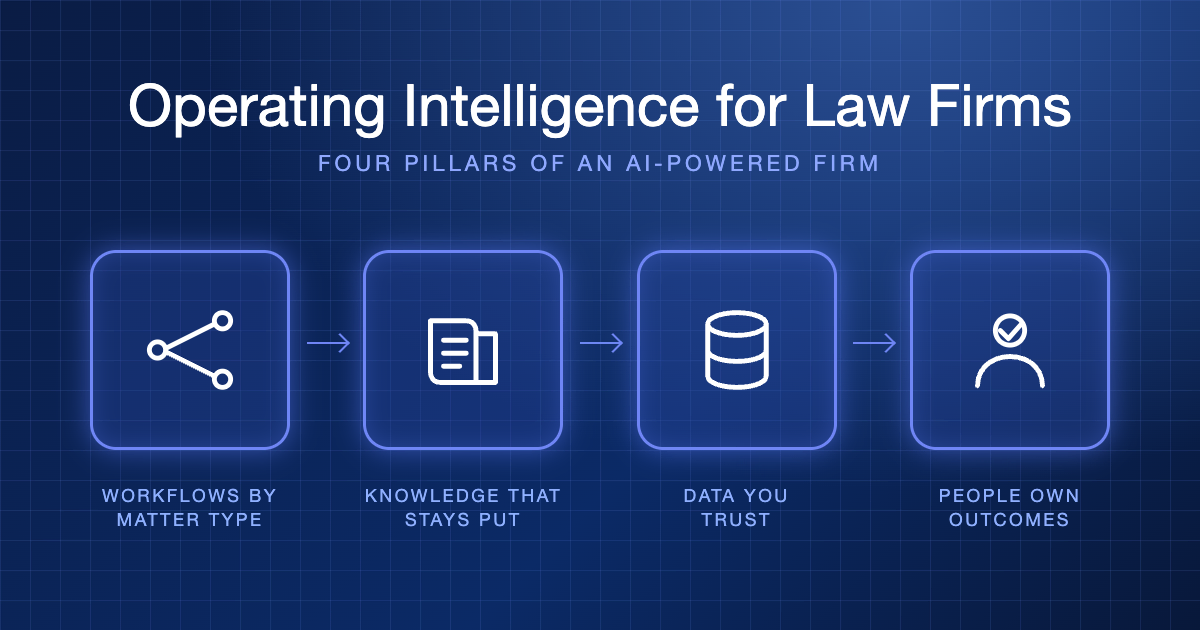
What Are the Four Pillars of Operating Intelligence?
1. Workflows by matter type
Ask three people how a new matter moves from intake to closure. If you get three different answers, you don’t have a workflow. You have folklore.
2. Knowledge that stays put
Your best templates. Your checklists. The “oh, for this court we always…” wisdom. If it walks out the door at 5 p.m., it isn’t firm knowledge. It’s a hostage situation.
3. Data you trust
Decisions, strategies and outcomes depend on being able to access complete and reliable data quickly. Make sure your AI provides citations with a link to view the source document for assurance the data is valid.
4. People own outcomes
AI can perform a lot of tasks quickly, but a member of your team still needs to own the result. Verification and accountability allow AI to transition from a novelty into an invaluable teammate.
A 60-Second OI Check
Answer honestly. Nobody’s grading you.
- Could a new hire follow your intake process without asking anyone?
- Is the workflow of each matter type mapped from intake to closure?
- If your most experienced team member quit tomorrow, would their know-how remain?
- Can you tell where each client’s case stands without digging?
- Are you highly confident that every step on a matter gets completed?
- Is the work of your newest paralegal just as good as your seasoned one?
Three or more “not really” answers? Good news. That isn’t a failing grade. It’s a roadmap, and you don’t have to draw it alone.
How Does Saxon™ Support Operating Intelligence?
Here’s what surprises most firm owners: you don’t have to perfect your operations before AI can help. The right system helps you build them.
Piecemeal AI saves minutes; end-to-end AI changes how the firm runs. That’s why we built Saxon™ as a Legal Execution System™ (LES): executable AI workflows that run your legal production from intake to closure.
Saxon™ Playbooks document every step of every matter type, so nothing slips through the cracks. And because the system does much of the heavy lifting, your newest paralegal can perform like your best and brightest.
That means:
- Every step, every time. No more “I thought someone else had that.”
- Polished work product. Typos and grammar gaffes never make it to the client.
- Less drama. When the process is clear, nobody argues about who dropped the ball.
Add Saxon™ KNOWledge, and your firm’s hard-won know-how stays put, even when people move on.
Your best paralegal’s brilliance, bottled and shared with the whole team. That’s OI for AI.