For med spa owners, the advantage isn’t being first to buy AI. It’s knowing where to use it—and how to turn patient interest into lasting relationships.
If you run a med spa, you’ve probably had more conversations about artificial intelligence in the past year than you ever expected. There is always a new receptionist, scribe, scheduling assistant or marketing tool promising to change your business.
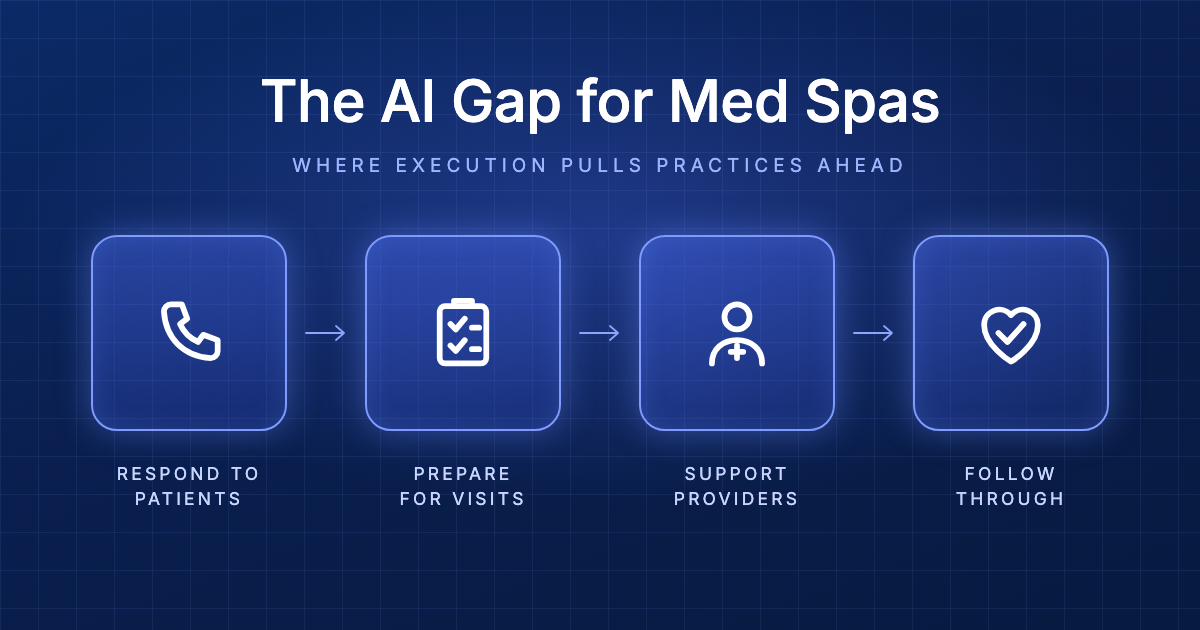
But buying technology isn’t the same thing as building a better practice. I believe the gap between med spas that thrive and those that struggle will come down to execution: how consistently they respond to patients, prepare for visits, support providers and follow through after treatment.
Why is AI becoming a priority for med spa owners?
AI matters because med spas are managing more competition, more patient information and higher expectations for personalized care—often without adding people to handle the work. That’s a business problem before it’s a technology problem.
The American Med Spa Association (AmSpa) reported 10,488 U.S. med spas in 2023, up from 8,899 in 2022. With more options available, patients have reasons to compare not only treatments and prices but also the entire experience: Does anyone answer the phone? Does the consultation address my goals? Does the provider remember what we discussed last time?
At the same time, clinical work is getting more complex. Practices that expand beyond aesthetics into wellness or longevity may need to coordinate additional patient history, lab results, contraindications, protocols and follow-up. The workload doesn’t disappear because the owner has a clinical background.
For me, the important question isn’t Should we use AI? It’s Which parts of the patient experience need to work better, and can AI help us improve them safely?
What separates growing med spas from the rest?
Top-performing businesses appear to be better at capturing and retaining patient demand, not simply charging more. The difference is visible in recent industry benchmarking.
At its 2026 Innergize conference, Zenoti shared performance data from more than 30,000 beauty and wellness businesses on its platform. The top 25% of businesses grew approximately 20%, versus roughly 2% for the average business. For med spas, visits grew 14% in the top quartile while falling 7% among the rest. These are Zenoti-platform benchmarks, not a measurement of every med spa in the country, but the contrast deserves attention.
The explanation Zenoti highlighted wasn’t a dramatic difference in ticket price. Leading businesses brought in more visits and lost fewer new guests.
Think about what that means for an owner. You might be spending money to attract new patients who then encounter missed calls, inconsistent answers or slow follow-up. You may also have existing patients who have other concerns your practice could address appropriately, but those goals never make it into the consultation or follow-up plan.
Before buying another marketing tool, I’d want to understand where those opportunities are slipping through the cracks.
Is the fastest AI opportunity at the front desk?
For some med spas, the first measurable AI opportunity is simply responding reliably when prospective patients reach out. It is also a useful place to establish how your team evaluates new tools.
In the same Zenoti presentation, 27% of analyzed calls went unanswered, and only 35% of missed calls were eventually reconnected. Among callers who explicitly intended to book, 37% did not end up with an appointment. These figures describe the calls in Zenoti’s analysis; your own practice may look different.
At Spa 35, we started with an AI receptionist. The aim was straightforward: give callers useful answers after hours, handle routine questions and make it easier to book rather than sending every inquiry to voicemail.
An owner should still ask practical questions. Does the system answer accurately? Does it know when to involve staff? How does it handle sensitive health questions? Can you measure bookings, missed calls and patient satisfaction before and after deployment?
The point is not to automate every conversation. It’s to stop losing patients because the practice is unavailable when they reach out.
What do repeat patients tell us about the opportunity?
Growth is not only about attracting new patients. It’s also about caring for the people who already chose your practice.
AmSpa’s 2024 report found that repeat patients represented an average of 73% of med spa patients, up from 65% in its 2022 report. Those are industry survey figures—not an individual practice’s retention rate—but they reinforce how important the ongoing relationship is.
A patient may arrive for Botox while also wanting to address skin texture, volume loss or another concern. If the visit focuses only on today’s booked service, you can miss the chance to understand the patient’s full goals. That isn’t a reason to push an unnecessary treatment. It’s a reason to ask better questions, document the answers and make sure the qualified clinician can consider the options.
This is where I think the conversation about AI needs to move beyond phones and reminders. The harder opportunity lies in helping the team prepare for a richer clinical conversation.
Why can’t software alone close the AI gap?
AI can support a well-run practice, but it cannot substitute for clear strategy, sound clinical judgment or a team that knows how to use it.
Before signing with a vendor, ask yourself:
- Where do we consistently lose time, information or patient trust?
- Which processes are already standardized, and which depend on one experienced person remembering everything?
- Are we measuring the patient experience, or only how many leads came in?
- Who will train, supervise and evaluate the AI once it goes live?
- How will we protect patient information and keep clinical decisions with qualified professionals?
A tool is only as useful as the workflow around it. The med spa that takes the time to answer these questions may be better positioned than the one that buys five tools in a hurry.
What comes after the front desk? Clinical intelligence.
Once a practice can capture patient interest, the next question is what happens in the consultation. The appointment is where patient history, goals, contraindications and treatment options need to come together.
That’s where Colette for med spas comes in. It’s designed to help clinicians bring that information together so they can focus on the conversation with the patient.
Colette is designed to organize intake, treatment history, patient goals and practice protocols ahead of the visit so the clinician can review the full picture and decide what care is appropriate. It is not a substitute for the provider’s judgment.
You don’t need to introduce clinical AI on day one. But I would evaluate any AI investment against the full patient journey, not just one task at the front desk.
The practices that pull ahead won’t necessarily be the first to adopt AI. They’ll be the ones that turn patient interest into consistent, thoughtful care.
Next in this series: How to Prepare Your Med Spa for AI: A Five-Step Plan.